
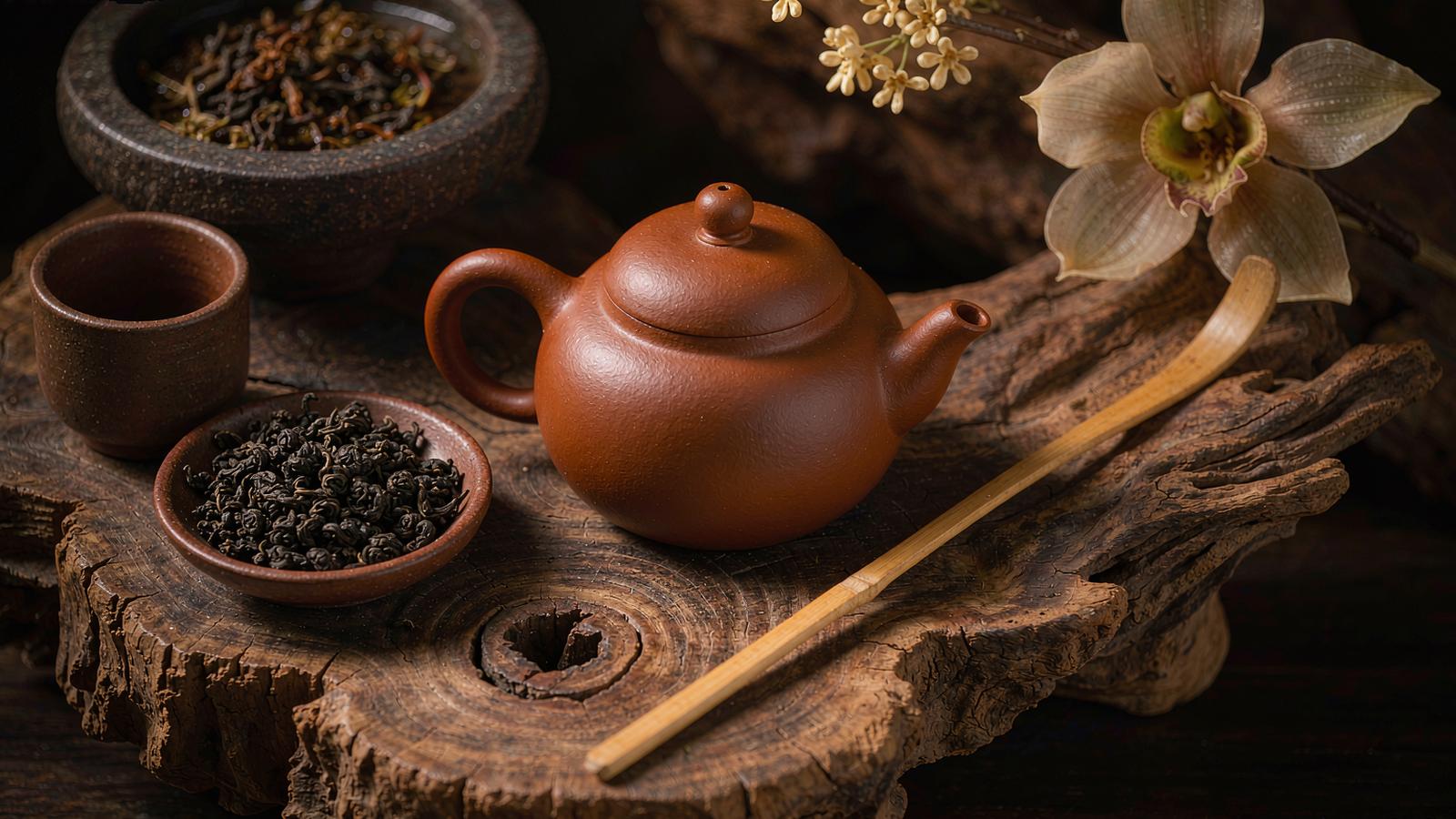
Oolong Tea: A Practical Guide to the Partially Oxidised Tea
Caffeine measured on brewed tea, brewing temperatures by oxidation level, the four growing regions, and how oolong differs from green and black tea — with every figure sourced.
Caffeine per cup Brewing guideThe short version
- Oolong is partially oxidised tea from Camellia sinensis — oxidation runs roughly 10% to 80%, which is why it covers more flavour ground than any other tea category.
- A typical 8 oz cup carries 30–55 mg of caffeine (USDA average about 38 mg), against 40–70 mg for black tea and 20–45 mg for green.
- Brewing temperature tracks oxidation: 85–90 °C for light oolongs, 92–95 °C for dark roasted ones.
- The English word oolong comes from the Chinese 烏龍 (wūlóng, "black dragon"). Merriam-Webster dates the first English use to 1845.
- Four regions dominate production: Anxi, Wuyi, Phoenix Mountain, and Taiwan.
Put oolong next to green tea and black tea and the middle ground looks like a compromise. It isn't. Oolong is the hardest tea category to make well, and the reason is that partial oxidation is a moving target. A green tea producer kills the enzymes almost immediately after picking. A black tea producer lets oxidation run to completion. An oolong maker has to watch the leaf change hour by hour and stop it at exactly the right moment — a skill that takes years and cannot be automated away.
What "partially oxidised" actually means
Oxidation here is not the same thing as exposure to air in storage. It is an enzymatic reaction that starts the moment leaf cells are damaged. Once the cell walls break, enzymes called polyphenol oxidases meet catechins in the leaf, and the catechins begin polymerising into theaflavins and thearubigins — the compounds that make black tea dark and brisk. Stop the reaction early and you keep most of the catechins intact, which is what gives green tea its grassy edge. Stop it somewhere in the middle and you get the floral, stone-fruit, sometimes creamy character that oolong is known for.
The numbers vary by source because oxidation is measured by eye and experience, not by instrument. Published ranges typically describe light oolongs at 10–30%, medium at 30–50%, and dark roasted at 50–80%. Treat those as bands, not precise readings. Two batches of the same cultivar can sit several points apart and both be correct.
Where the name comes from
烏龍 (wūlóng) translates as "black dragon", and the dried leaf of a heavily roasted Wuyi oolong does look like something a dragon might have shed: long, twisted, dark. The English spelling oolong entered the language from the Xiamen (Amoy) pronunciation, which is why it predates pinyin and why older texts sometimes write "oulong". Merriam-Webster records 1845 as the earliest known English use. The pinyin form wulong shows up in modern writing but remains a minority spelling; oolong is still what English speakers search for and what tea vendors put on their labels.
The four regions that matter
| Region | Country | Signature teas | Typical character |
|---|---|---|---|
| Anxi, Fujian | China | Tieguanyin | Floral, orchid, sometimes creamy; rolled into tight pellets |
| Wuyi Mountains, Fujian | China | Da Hong Pao, Rou Gui, Shui Xian | Roasted, mineral, thick; strip-shaped dark leaf |
| Phoenix Mountain, Guangdong | China | Dancong (Mi Lan Xiang, Ya Shi Xiang) | High aromatics, honey-orchid; long twisted leaf |
| Nantou, Chiayi, Taipei | Taiwan | Alishan, Dong Ding, Dongfang Meiren | Buttery, floral, low roast; ball-rolled or open leaf |
Taiwanese high-mountain oolongs get picked at altitude — Alishan and Lishan plantings sit well above 1,000 metres — and the slower growth at that elevation is credited with the soft, sweet, low-astringency cup they are known for. Dongfang Meiren, sold in English as Oriental Beauty, is unusual because the leaf is intentionally bitten by a small leafhopper before harvest; the insect damage triggers a chemical response in the plant that produces its honeyed, ripe-fruit aroma. It is one of the few teas where pest damage raises the price.
How oolong is made
The full sequence runs longer than any other tea category:
- Plucking — usually a standard of two or three leaves and a bud, though some Wuyi producers take more mature leaf.
- Withering — sun-withering or indoor withering to draw moisture out and soften the leaf so it can be bruised without tearing.
- Bruising / shaking (做青) — the step that defines oolong. Leaf is tumbled or shaken in bamboo trays repeatedly over several hours. Each round damages the leaf edges a little more, driving oxidation forward in controlled increments.
- Fixation (杀青) — a hot pan or steaming step that denatures the enzymes and stops oxidation where the maker wants it.
- Rolling — either into tight pellets (Anxi, Taiwan) or into long strips (Wuyi, Dancong). Shape affects how fast the leaf gives up flavour later.
- Drying and roasting — a first drying, then often one or more rounds of charcoal or electric roasting. Roasting can be repeated months apart for Wuyi rock teas.
The shaking step is the one nobody can shortcut. It runs for hours, it is judged by smell and by how the leaf feels, and it is the reason a skilled oolong maker is paid like a skilled winemaker.
How much caffeine is in it
A standard 8 oz cup of oolong delivers roughly 30–55 mg of caffeine, with the USDA average sitting near 38 mg. That places it between green tea (20–45 mg, USDA average about 28 mg) and black tea (40–70 mg, USDA average about 47 mg), and well under drip coffee at around 95 mg. The overlap between categories is large: a strong green tea can out-caffeinate a light oolong, because water temperature and steep time move the number as much as leaf type does. The full breakdown, including how much a 30-second rinse removes, is on the oolong tea caffeine page.
What it tastes like
The honest answer is that there is no single oolong flavour. A lightly oxidised Taiwanese high-mountain oolong tastes like orchids and cream; a charcoal-roasted Da Hong Pao tastes like wet stone, dark sugar and toasted grain. Both are oolong, and they share almost nothing. If you want the flavour map before you buy anything, start with what does oolong tea taste like.
Brewing it without ruining it
Two rules cover most of the damage. First, match water temperature to oxidation: 85–90 °C for light oolongs, 90–95 °C for medium, and up to 95 °C for dark roasted leaf. Boiling water on a delicate green oolong scorches it and flattens the aroma. Second, don't throw the leaf away after one steep. Good oolong is built for re-infusion — gongfu brewing pulls 6 to 12 infusions from a single portion, and the third through fifth are usually where the tea peaks. The full parameters, including a leaf-ratio table for both methods, are in how to brew oolong tea.
Oolong next to green and black tea
People ask this constantly, usually as a yes/no question, and the answer is that oolong is neither. It sits on a continuum defined by how far oxidation was allowed to run. If you only want the practical difference — caffeine, flavour, brewing temperature — the two comparison pages lay it out side by side: oolong vs green tea and oolong vs black tea.
Telling a light oolong from a roasted one
You can usually sort them by eye before water touches anything. Lightly oxidised oolongs arrive as tight green pellets or as open twisted leaf in shades of jade and olive, and the dry leaf smells like cut grass or fresh flowers. Heavily roasted oolongs are strip-shaped and brown to near-black, and the dry leaf smells of toasted grain, sometimes dark caramel. When a vendor lists neither the region nor the roast level, that is itself a signal — teas worth a premium get described precisely, because the producer wants you to know what they did.
Roasting also decides how forgiving a tea is. A charcoal-roasted Wuyi oolong survives boiling water and a five-minute steep and still tastes like something. A high-mountain Taiwanese oolong treated the same way turns bitter and drops every aromatic note it had. Most disappointing oolong experiences trace back to that one mismatch rather than to bad leaf.
Oolong is not pu-erh
The two get confused constantly, and the confusion costs people money. Pu-erh is also a Chinese tea sold in compressed cakes and also dark in the cup, but it is a different category: it is fermented by microbes after fixation rather than oxidised by enzymes before it, and it is the one tea that genuinely improves over decades of storage. Oolong does not. A light oolong kept for ten years is not a treasure, it is a tea that has lost its aroma. If a seller offers you aged oolong at a premium on the strength of age alone, that is a pu-erh argument being applied to a tea it does not apply to.
The practical difference: buy pu-erh to lay down, buy oolong to drink. There is one partial exception, and it is roasted Wuyi rock tea, which does settle and improve over a year or two of rest after roasting — months and a handful of years, not decades. Storage detail by style is on the oolong tea storage page.
Storing it
Oolong keeps longer than green tea and not as long as pu-erh. Keep it sealed, away from light, heat and strong smells; an airtight tin or the original foil pouch with the air squeezed out both work. Roasted oolongs are the most forgiving and can sit a year or two without much change. Light, unroasted oolongs lose their aromatics fastest — drink those inside six to twelve months. Skip the fridge for anything you open daily, because condensation does more damage than the warmth you were avoiding. If you are laying tea down for years, portion it first and let each portion return to room temperature before you break the seal.
Buying it
Buy whole leaf. Oolong is a re-steeping tea, and broken leaf or dust — the grade packed into most paper tea bags — gives up everything in one steep and then turns bitter. A tightly rolled pellet looks like a small portion dry and then expands to fill a gaiwan once wet, which surprises most first-time buyers. Where the good stuff comes from, what a fair price looks like, and what to avoid on marketplaces are covered on the loose leaf oolong tea page.
One thing worth knowing before you spend money: oolong is priced by cultivar, elevation and harvest date far more than by brand. Two vendors selling "Tieguanyin" at four times the price difference may be selling plausible but unrelated tea, because the name describes a cultivar and a style rather than a protected origin. Alishan, Dong Ding and Wuyi rock teas carry origin protection in practice if not always in law. Ask for the harvest season and the specific garden, and read a vague answer as an answer.
Questions people actually ask
Is oolong tea green tea or black tea?
Neither. All three come from the same plant, Camellia sinensis, and the difference is how far oxidation runs before the maker stops it. Green is barely oxidised, black is fully oxidised, and oolong lands somewhere between, typically quoted as 10% to 80% depending on style.
Does oolong tea have caffeine?
Yes. A standard 8 oz cup contains roughly 30 to 55 mg, with the USDA average near 38 mg. That is less than black tea (40 to 70 mg) and more than green tea (20 to 45 mg), though a long hot steep pushes any of them higher.
What does oolong taste like?
It depends almost entirely on oxidation and roast. Light oolongs are floral, creamy and fresh; medium ones run to peach, honey and orchid; dark roasted Wuyi oolongs are mineral and toasty. The category covers a wider flavour range than green or black.
How many times can you steep oolong leaves?
A good oolong gives 6 to 12 infusions brewed gongfu style, and 2 to 3 brewed Western style in a mug or teapot. Flavour usually peaks somewhere in the third to fifth infusion.
What water temperature should I use?
Match it to oxidation: 85 to 90 °C for light oolongs, 90 to 95 °C for medium, and up to 95 °C for dark roasted leaf. Boiling water is fine for Wuyi rock tea and a mistake for a delicate green-oolong.
Where these figures come from
- USDA FoodData Central — per-serving caffeine values for brewed tea
- Merriam-Webster: oolong — earliest recorded English use, 1845
- Journal of Agricultural and Food Chemistry — peer-reviewed work on tea chemistry, including caffeine extraction over steep time and the aroma compounds behind oolong flavour