
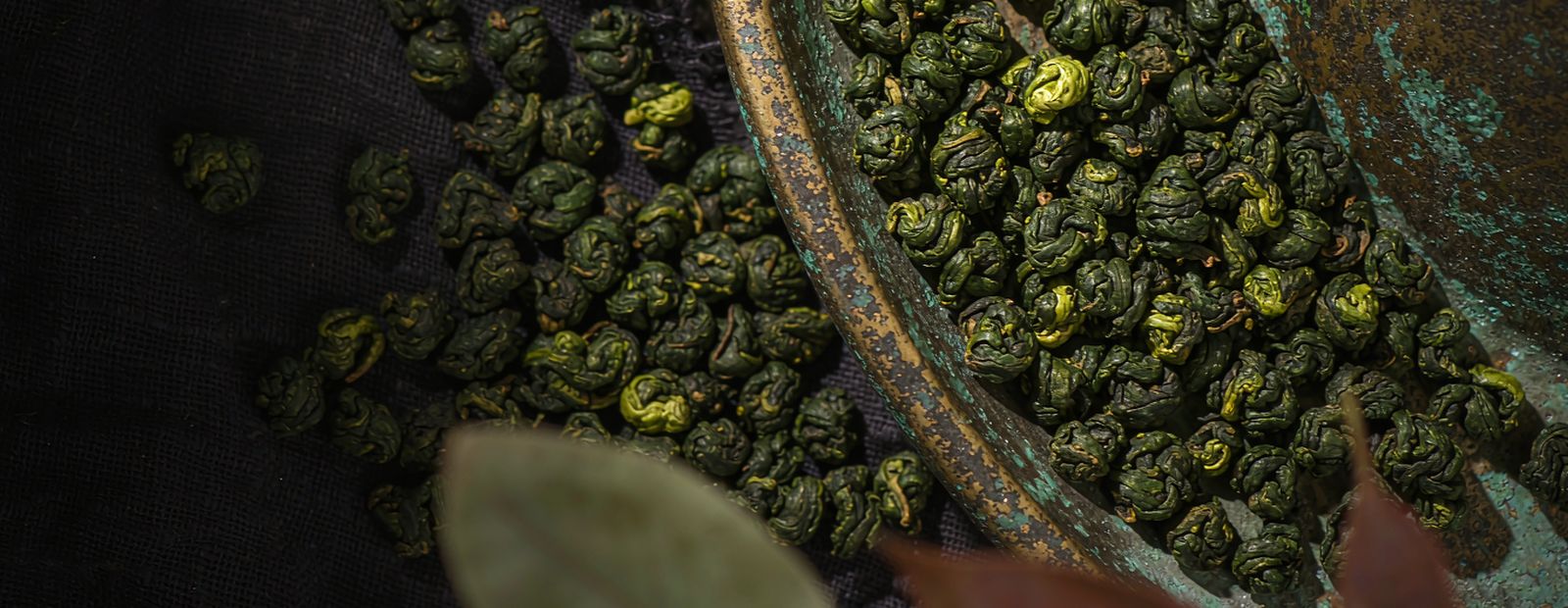
Milk Oolong (Jin Xuan): What It Is and Whether It's Flavoured
Milk oolong is Jin Xuan, a Taiwanese cultivar whose creamy note is natural - no milk added. How to spot flavoured versions and how to brew it at 85-90 C.
The short version
- Milk oolong is Jin Xuan (金萱), a Taiwanese cultivar also known as #12, bred in the 1980s.
- The creamy note is natural to the cultivar — no milk and no flavouring involved.
- Typical profile: cream, coconut, light florals, very low astringency.
- Brew at 85–90 °C, 3–4 minutes Western or short gongfu steeps.
- If it smells strongly of dessert, it was probably flavoured. Natural Jin Xuan is subtle.
The name puts people off, and understandably: a tea called milk oolong sounds like it has been sprayed with something. In its authentic form it has not. Jin Xuan was bred for yield and for a naturally milky character, and the creaminess survives into the cup without any processing trick. The confusion is entirely the fault of the second category of product sold under the same name.
Where the creaminess comes from
Jin Xuan is a cross involving the Taiwanese native mountain tea and a larger-leafed cultivar, bred in Taiwan in the early 1980s and numbered 12 in the breeding programme — hence "#12", which appears on Taiwanese packaging alongside the name. Whatever the precise genetic route, the result carries a lactone profile that reads as cream and coconut to most drinkers. It is strongest in lower-elevation plantings and in winter harvests, and it fades with heavy roasting, which is why milk oolong is almost always sold lightly oxidised and lightly roasted.
Vendors occasionally explain the name by saying the leaves were steamed with milk. That is a marketing story, not a production method. Authentic Jin Xuan is processed exactly like any other lightly oxidised Taiwanese oolong.
Two products, one name
| Signal | Authentic Jin Xuan | Flavoured |
|---|---|---|
| Dry leaf aroma | Faint cream, floral, clean | Strong, sweet, dessert-like |
| Cream note in cup | Subtle, builds across infusions | Dominant in steep 1, gone by steep 3 |
| After 3 steeps | Still creamy and floral | Plain, sometimes stale |
| Ingredients listed | Oolong tea | Natural flavour, flavouring, or nothing stated |
| Pellet appearance | Tightly rolled, matte green | Often glossier, sometimes coated |
Flavoured milk oolong is not dangerous and some of it is pleasant. What it is not is a good way to learn what the category tastes like, and it does not re-steep, because the flavouring washes out in the first infusion and leaves ordinary leaf behind. If you are paying a premium, buy from a vendor who names the cultivar and the harvest.
How to brew it
Treat it as a light oolong, because that is what it is. Use 85–90 °C water — boiling water kills the cream note and pushes out astringency, which is the main complaint people have about milk oolong that they caused themselves.
- Western: 2–3 g per 8 oz, 3–4 minutes, lid on. Two to three steeps.
- Gongfu: 5–6 g per 100 ml gaiwan, rinse 5 seconds, then 25–35 second steeps. Six to nine infusions, with the cream note usually most obvious in the second to fourth.
It takes cold brewing unusually well — about 10 g per litre, 8 to 12 hours in the fridge produces something close to a lightly sweetened milk tea without any sugar. Full parameters are in how to brew oolong tea.
Caffeine
Milk oolong sits in the normal oolong band, roughly 30–50 mg per 8 oz cup depending on how it was brewed, against a category average of about 38 mg. It is not a low-caffeine tea and it is not a high one. Brew it cooler and shorter if the number matters to you. The full comparison is on the oolong tea caffeine page.
Where it is grown, and why that matters less than usual
Jin Xuan is unusual among Taiwanese teas in that it is mostly planted at lower elevation. The cultivar was bred partly for yield and hardiness, and it performs well in the lower and middle elevation bands where the famous high-mountain cultivars would produce thin, uninteresting tea. Some high-elevation Jin Xuan exists and commands a premium, but it is not the classic article and the cream note is often weaker in it.
The practical effect is on price. Because it is grown at lower elevation and harvested over a longer window, Jin Xuan is generally cheaper than Alishan or Lishan oolong of comparable freshness, which is part of why it is such a common first purchase. It also means the quality floor is lower: cheap Jin Xuan can be bland in a way cheap high-mountain tea rarely is, because there is no altitude-driven sugar to fall back on.
Jin Xuan next to the other Taiwanese cultivars
| Cultivar | Also known as | Character | Typical elevation |
|---|---|---|---|
| Jin Xuan | #12, milk oolong | Cream, coconut, light floral | Low to mid |
| Qing Xin | Chin-shin, #17 | Orchid, clean, the high-mountain standard | Mid to high |
| Si Ji Chun | Four Seasons | Bright, floral, slightly grassy | Low to mid |
| Cui Yu | Jade, #13 | Fresh, green, lightly floral | Low to mid |
Qing Xin is the cultivar behind most Alishan and Dong Ding oolong, and it is the one Jin Xuan gets compared against: less distinctive, but more elegant, and it carries altitude better. Si Ji Chun is the workhorse cultivar at lower elevation and produces reliable, pleasant tea without much personality. If you like Jin Xuan and want to move up, Qing Xin is the step; if you want something cheaper for daily drinking, Si Ji Chun is.
How to tell you have the real thing
Buy from a vendor who names the cultivar — "Jin Xuan" or "#12" — rather than one who only says "milk oolong". Naming the cultivar costs the seller nothing if it is accurate and exposes them if it is not, so its absence is informative. Regional labelling helps too: Taiwanese Jin Xuan is the classic article, while Jin Xuan grown elsewhere produces a recognisable but usually weaker cream note.
Brew it and watch the third infusion. Authentic Jin Xuan keeps its cream character through the middle steeps and fades gently. A flavoured tea peaks in the first infusion and is ordinary by the third, because the flavouring has washed off. That single test settles it more reliably than anything on the packet.
Roasted Jin Xuan exists too
Most milk oolong is sold lightly roasted, because roasting suppresses the cream note that gives the tea its name. Roasted Jin Xuan is made and is worth trying if you like the cultivar but find it thin: the roast adds body and a nutty sweetness, and a trace of the cream survives underneath. Expect to look harder for it — most vendors keep only the green style, because that is what the name sells.
Who it suits
Milk oolong is the safest recommendation for someone who has never drunk oolong and for anyone who has tried one and found it too grassy or too astringent. It is forgiving to brew, mild enough to drink without thinking, and distinctive enough to be interesting. It is also the tea most likely to convert someone who claims not to like tea at all.
If you already know you prefer the roasted end of the category, Jin Xuan will taste thin to you — go to oolong tea varieties and pick something from the Wuyi row instead.
Where the naming comes from
Jin Xuan is a registered Taiwanese cultivar, and the name means "golden spring shoot" - the buds were valued enough to be picked separately before the cultivar spread. That detail matters when you shop: "milk oolong" as a category name is recent and mostly marketing, while Jin Xuan as a cultivar name is traceable, so a vendor who names the cultivar is telling you more than one who only says milk oolong. As with the rest of the site, treat the health language around this tea as unproven: the US National Center for Complementary and Integrative Health's review of tea research found that most human studies are small and short, and that oolong specifically is thinly covered in the literature compared with green tea.
Questions people actually ask
Does milk oolong actually contain milk?
No. Milk oolong is Jin Xuan, a Taiwanese cultivar whose natural creamy and coconut-like note comes from the plant. No milk, cream or dairy is involved in authentic Jin Xuan. Some separately sold products are flavoured, so check the ingredient list if the aroma is very strong.
Is milk oolong flavoured?
Authentic Jin Xuan is not flavoured - the creaminess is natural to the cultivar. Flavoured versions exist and are common in gift shops and marketplaces. Tell them apart by the dry-leaf aroma and by whether the cream note survives the third infusion.
What cultivar is milk oolong?
Jin Xuan (chin-hsuan), also labelled #12 after its number in the Taiwanese breeding programme. It was developed by Taiwan's Tea Research and Extension Station and released in the 1980s.
How do you brew milk oolong?
At 85-90 C, not boiling. Western style: 2-3 g per 8 oz for 3-4 minutes. Gongfu style: 5-6 g per 100 ml with 25-35 second steeps for six to nine infusions. Boiling water flattens the cream note and brings out astringency.
How much caffeine is in milk oolong?
Roughly 30-50 mg per 8 oz cup depending on brewing, in the normal oolong range (category average about 38 mg). It is neither a high nor a low caffeine tea.
Where these figures come from
- NCCIH: green tea — US government summary of what tea research does and does not show
- Merriam-Webster: oolong — earliest recorded English use, 1845