
Oolong vs Green Tea: What's Actually Different
Oolong and green tea come from the same plant. Compare oxidation, caffeine, brewing temperature, flavour and shelf life - and which one you should actually drink.
The short version
- Both come from Camellia sinensis. The only structural difference is how far oxidation runs before it is stopped.
- Green tea is barely oxidised (under about 10%); oolong runs roughly 10% to 80%.
- Caffeine: green 20–45 mg per 8 oz (USDA average about 28 mg) vs oolong 30–55 mg (about 38 mg).
- Water: green wants 75–85 °C; oolong wants 85–95 °C depending on roast.
- Flavour: green is grassy, vegetal and marine; oolong runs floral, creamy, fruity or toasty.
This is the most-searched oolong comparison and the easiest one to answer badly, because the honest answer is "it depends which oolong". A lightly oxidised Baozhong sits close to green tea on every measurable axis. A charcoal-roasted Da Hong Pao shares almost nothing with it. Any comparison that treats oolong as one thing will get this wrong, so the table below gives both ends of the oolong range.
Side by side
| Attribute | Green tea | Oolong (light) | Oolong (dark roast) |
|---|---|---|---|
| Oxidation level | Under ~10% | 10–30% | 50–80% |
| Caffeine per 8 oz | 20–45 mg (avg ~28) | 30–50 mg | 35–55 mg |
| Water temperature | 75–85 °C | 85–90 °C | 95 °C to boiling |
| Western steep | 1–3 min | 2–3 min | 4–5 min |
| Infusions | 2–3 | 6–10 | 8–12 |
| Dominant flavour | Grass, seaweed, sweet corn | Orchid, cream, fresh flowers | Toasted grain, mineral, dark sugar |
| Shelf life | 6–12 months | 12–18 months | 2+ years |
| Heat fixation method | Steamed (Japan) or pan-fired (China) | Pan-fired after shaking | Pan-fired, then roasted |
The processing difference, in one paragraph
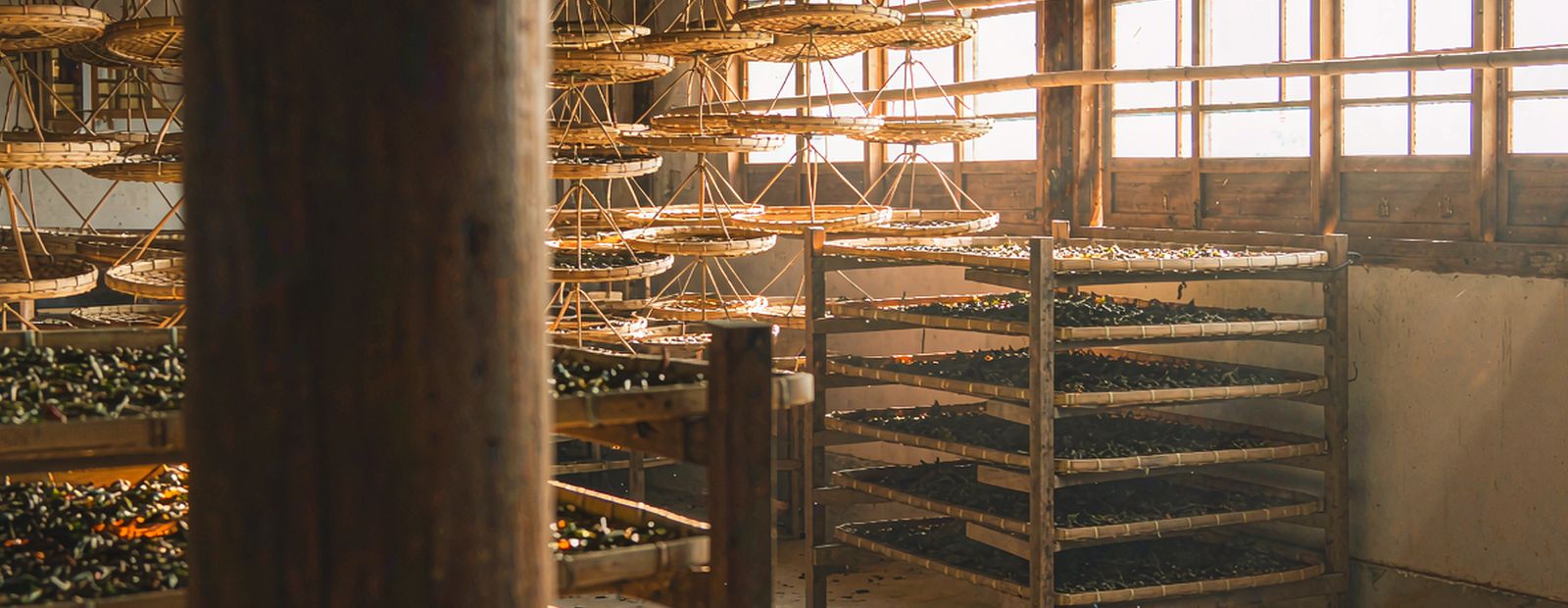
Green tea is picked, withered briefly, and then fixed — steamed in the Japanese style or pan-fired in the Chinese style — within hours, which denatures the polyphenol oxidase enzymes before they can do much. Oolong adds a step before fixation: the leaf is repeatedly shaken or tumbled in bamboo trays over several hours, bruising the edges and letting oxidation creep forward a little at a time. Only when the maker judges it ready does the same fixation step happen. That shaking stage is what produces oolong's aroma compounds, and it is the reason the category covers so much flavour ground.
Caffeine: smaller gap than the labels suggest
On averages, oolong carries roughly 10 mg more caffeine per cup than green tea. Both ranges are wide enough that they overlap, and brewing practice moves the number more than the category does. A Japanese sencha brewed at 80 °C for 60 seconds will test lower than almost any oolong; the same sencha brewed at 90 °C for three minutes will test higher than a light oolong brewed the usual way. If caffeine is the deciding factor for you, control the water temperature and steep time rather than the tea. Full numbers are on the oolong tea caffeine page.
What oxidation does to the chemistry
The compounds people associate with green tea — EGCG and the related catechins — are exactly what partial oxidation consumes. As polyphenol oxidase works on the leaf, catechins polymerise into theaflavins and then thearubigins, and measurable catechin content falls. A lightly oxidised Baozhong keeps most of its catechins; a heavily oxidised Wuyi tea keeps far fewer and carries markedly more of the larger polymerised compounds instead.
That is the honest basis for comparing the two, and it cuts both ways. If you specifically want catechins, green tea delivers more per gram. If you want the polymerised compounds that black tea is studied for, dark oolong has some and green tea has almost none. Neither difference translates cleanly into a health outcome, which is why the benefits page declines to rank them.
Price, availability and how easy each is to buy well
Green tea is cheaper and easier to buy competently. A supermarket sencha is usually recognisably sencha; a supermarket oolong is frequently old, broken or mislabelled. The reasons are structural. Green tea is judged on freshness and appearance, both visible in a photograph, while oolong quality depends on oxidation level, roast and origin, none of which a listing is obliged to state.
At the top end the gap closes, because good vendors of either category state cultivar, origin and harvest. Budget roughly twice as much per gram for a decent oolong as for a decent green tea, then remember that the oolong re-steeps three to four times as often — which is where the value actually comes from. Buying detail is on loose leaf oolong tea.
Which is easier to brew at a desk
Green tea, comfortably. It tolerates one mug, a short steep and an approximate temperature better than oolong does, and it does not punish boiling water quite as harshly as a delicate high-mountain oolong will. Oolong's advantage appears only once you have a few minutes and a vessel you can decant from. That trade-off — attention, not caffeine — is the real difference between them.
Which one to give someone
Green tea is the safer gift, because the recipient probably already knows what to do with it and it is forgiving of a mug, a kettle and no attention. Oolong as a gift works best when it comes with instructions, because a delicate high-mountain oolong handed to someone who brews it at boiling will be judged as bad tea rather than badly brewed tea. If you are giving oolong, give a roasted Wuyi tea: it survives every mistake and it keeps for years.
Both, in practice
Most people who settle into tea drink both, by season and by time of day. Green tea is the summer and morning drink: fresher, lighter, quicker. Oolong is the cooler-month and afternoon drink: warmer, more aromatic, built for a longer sit. There is no reason to treat it as a decision, and the two cost roughly the same per cup once you account for how many times each re-steeps.
Which one should you drink?
Pick green tea if you want something clean, low-caffeine and quick to make, and if you like the vegetal, slightly marine character that good sencha and Chinese green teas have. It is the easier tea to brew at a desk and the more forgiving one if your water is not great.
Pick oolong if you want aroma complexity and you are willing to pay attention for four minutes. Oolong rewards a gongfu session in a way green tea generally does not, and it re-steeps far better — six to twelve infusions against two or three. It also keeps longer in the cupboard, which matters if you buy in quantity.
If you are coming from coffee and want the closest thing to it that is still tea, oolong is the better bridge. Its body and roast character read as more familiar than green tea's grassiness.
The one thing that trips people up
People brew their first oolong the way they brew green tea and conclude oolong is bitter and overrated. The failure is temperature. Green tea habit teaches 80 °C, and that is fine for Baozhong but far too cool for a roasted Wuyi tea, which needs water at 95 °C or above to open at all. The reverse error is more common still: boiling water on a delicate high-mountain oolong. Both mistakes are temperature mistakes, and both are fixed by reading how to brew oolong tea once.
For the other side of the comparison, see oolong vs black tea.
Questions people actually ask
Is oolong tea the same as green tea?
No, though both come from Camellia sinensis. Green tea is fixed almost immediately after picking so oxidation stays very low; oolong is oxidised partway, typically 10% to 80%, before fixation. That one processing difference drives the flavour, colour and caffeine differences.
Which has more caffeine, oolong or green tea?
Oolong on averages: about 38 mg per 8 oz against about 28 mg for green tea, per USDA data. The ranges overlap substantially (oolong 30-55 mg, green 20-45 mg), so brewing method can reverse the result.
Can I brew oolong the same way as green tea?
Not if you want good results. Green tea is usually brewed at 75-85 C; a roasted oolong needs 95 C or hotter and a delicate light oolong needs 85-90 C. Using one temperature for both is the most common way to ruin oolong.
Is oolong healthier than green tea?
Neither is meaningfully healthier. Both contain catechins and L-theanine in differing proportions, and neither is a substitute for medical treatment. Regulatory bodies in the US and EU do not permit disease-prevention claims for either.
Which tastes less bitter?
A light oolong brewed correctly is usually less bitter than green tea, because lower brewing temperatures and short infusions extract fewer astringent tannins. A green tea over-steeped at high temperature is the most bitter cup in either category.
Where these figures come from
- USDA FoodData Central — per-serving caffeine values for brewed tea
- NCCIH: green tea — US government summary of what tea research does and does not show