
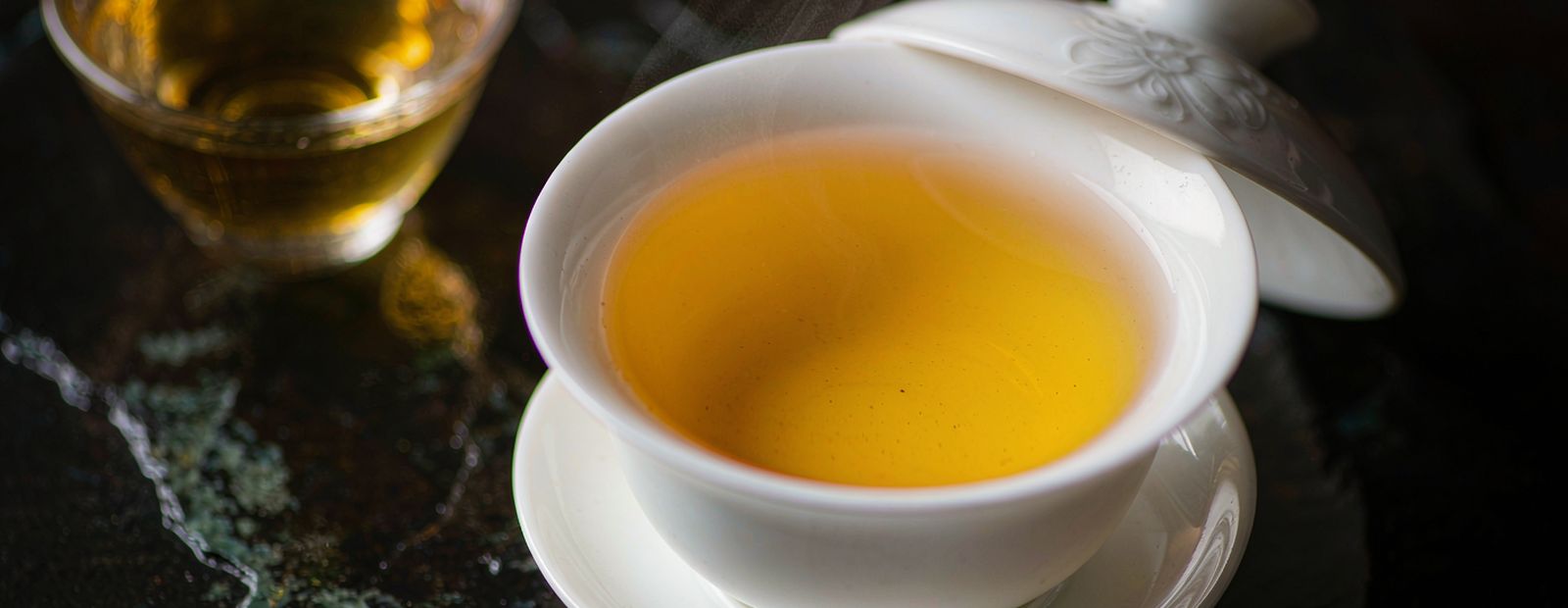
What Does Oolong Tea Taste Like?
Oolong runs from floral and creamy at the light end to mineral and toasty at the roasted end. Flavour grid by style, and why bitterness is usually a brewing fault.
The short version
- There is no single oolong flavour — oxidation and roast move it from floral to toasty.
- Light oolongs: orchid, cream, fresh butter, cut grass.
- Medium: peach, apricot, honey, orchid.
- Dark roasted: wet stone, toasted grain, dark caramel, sometimes smoke.
- Bitterness and astringency are almost always a brewing fault, not the tea.
"What does oolong taste like" is the question with the least useful answer, because the category spans a wider flavour range than green and black tea combined. The useful version of the answer is a map: know where a given tea sits on the oxidation-roast grid, and you can predict what it will taste like before you buy it.
The flavour grid
| Style | Oxidation | Liquor colour | Primary notes | Mouthfeel |
|---|---|---|---|---|
| Baozhong | 8–12% | Pale yellow-green | Fresh flowers, seaweed, sweet corn | Thin, clean |
| Alishan high mountain | 15–25% | Pale gold | Butter, orchid, sugarcane | Silky, soft |
| Jin Xuan (milk oolong) | 20–30% | Pale gold | Cream, coconut, light floral | Round, creamy |
| Traditional Dong Ding | 30–40% | Golden amber | Toasted nut, caramel, orchid | Medium body |
| Green Tieguanyin | 20–30% | Pale gold | Orchid, fresh green, sweet finish | Light, clean |
| Roasted Tieguanyin | 40–50% | Deep amber | Dried fruit, toasted grain | Round, warm |
| Mi Lan Xiang Dancong | 30–50% | Orange-gold | Honey, orchid, almond | Perfumed, brisk |
| Da Hong Pao | 50–80% | Deep orange-brown | Wet stone, dark sugar, char | Thick, coating |
| Rou Gui | 50–80% | Deep orange | Spice, cinnamon-like warmth | Thick, pungent |
Why the same word describes opposite flavours
Two people can both describe an oolong as "floral" and mean completely different things. Dancong florals are loud, perfumed and borderline soapy. High-mountain florals are quieter and sit under the butter and sugar. Roasted Wuyi teas have florals too, but they arrive buried under mineral and char. Tasting notes are written by people who know which family they are drinking, so a note without the family attached is close to useless.
Roast is the axis people underestimate. Two teas from the same cultivar, one roasted and one not, will share almost no detectable flavour. Roasting drives off the volatile compounds responsible for floral aroma and builds the Maillard and caramelisation products responsible for toast and sugar.
The sweetness at the finish
Chinese tea vocabulary has a term for the specific aftertaste good oolong leaves: 回甘 (huí gān), "returning sweetness". It describes a sweet sensation that arrives after swallowing rather than during the sip, sometimes thirty seconds later. It is not sugar in the tea — it is a contrast effect and possibly a real salivary response to the polyphenols, and the mechanism is not settled. What matters practically is that it is the single best cheap indicator of quality. Leaf that produces it is usually well grown and well made; leaf that does not is usually not.
What bad oolong tastes like
- Bitter and drying. Over-extraction. Water too hot or steep too long, on a tea too delicate for that treatment.
- Flat, papery, no aroma. Old leaf, or leaf stored open to air. Light oolongs lose their scent within a year if not sealed.
- Astringent from the first sip. Often low-elevation leaf picked too mature, or a harvest outside the spring and winter windows.
- Harsh smoky edge on a rock tea. Usually just-recently roasted. Give it six months.
- Perfumed in a way that tastes synthetic. On milk oolong in particular this can mean actual flavouring was added. Natural Jin Xuan is subtle; a milk oolong that tastes like a dessert was probably sprayed.
Bitter, astringent and sour are three different faults
Tea writing collapses these into one complaint, and they have different causes and different fixes. Bitter is a taste, detected on the tongue, and it comes from over-extraction — too hot, too long, too much leaf. Astringent is not a taste at all: it is the drying, puckering physical sensation produced when polyphenols bind with proteins in your saliva, and it is inherent to the leaf rather than caused by your brewing, though over-extraction makes it worse. Sour is spoilage, and it means the leaf took on moisture.
Separating them is the fastest way to fix a cup you do not like. Bitterness responds to brewing changes. Astringency responds partly to brewing and partly to buying better leaf — low-elevation leaf picked too mature is astringent no matter how gently you brew it. Sourness responds to nothing except replacing the tea.
How the flavour moves across infusions
A single tasting note describes one moment, which is why they mislead. Across a gongfu session a good oolong changes in a fairly predictable arc: the first infusion is dominated by aroma, the second and third by flavour, the fourth and fifth by body and sweetness, and the later ones by a thin residual sweetness that fades into water. Judging a tea on infusion one is like judging a wine on the cork.
Roasted teas run a slightly different curve, because roast character sits on top of everything and dominates the early infusions before receding to let the underlying cultivar show through around the fourth. That is the reason rock tea drinkers talk about a tea "opening up" — it is literally the roast washing off.
A small vocabulary that actually helps
Most tasting vocabularies are useless because they are either too vague ("smooth") or too idiosyncratic ("wet river stones after rain"). Four axes cover almost everything worth saying about oolong:
- Aroma family — floral, fruity, creamy, grassy, roasted, spicy, mineral.
- Body — thin, silky, round, thick, coating.
- Sweetness — where it sits: front, mid-palate, or as a late aftertaste.
- Finish — clean, sweet, drying, or lingering.
Name the family first, then those three, and you have said something useful in twelve words. Note the wet leaf smell as well as the liquor — most of the aromatic information in oolong is in the spent leaf and the empty cup rather than in the liquid.
Describing it if you are writing tasting notes
The fastest route to useful notes is to separate aroma, taste, mouthfeel and finish, and to name the family first. "Roasted Wuyi, charcoal: wet stone and dark sugar, thick, drying finish" tells someone something. "Nice, smooth, slightly sweet" does not. Smell the wet leaf after pouring — most of the aromatic information is in the spent leaf and the empty cup rather than in the liquor.
How to taste across the range cheaply
Buy four small samples rather than one large pouch: something light (Baozhong or Alishan), something creamy (Jin Xuan), something medium (traditional Dong Ding), something roasted (Rou Gui or Shui Xian). Brew them back to back the same afternoon at the parameters in how to brew oolong tea. Half an hour of that teaches more than any description on this page.
Once you know which end you like, the style map on oolong tea varieties tells you which teas sit near it, and the oolong tea guide covers what the categories have in common.
What the research actually covers
Two things on this page come from published work rather than tasting convention. The aroma language - floral, creamy, mineral, stone fruit - tracks the volatile compounds that tea researchers measure in the headspace of brewed leaf; those profiles differ enough between cultivars that a trained panel can identify origin from aroma alone, which is the basis of the sourcing claims vendors make. The health framing is narrower than the marketing: the US National Center for Complementary and Integrative Health reviewed the tea literature and concluded that most studies show association rather than cause, and that findings for green tea do not automatically transfer to oolong, which has been studied far less. So the honest reading of the flavour map above is descriptive - it tells you what to expect in the cup, not what the cup will do for you.
Questions people actually ask
What does oolong tea taste like?
It ranges from floral and creamy at the light end to mineral and toasty at the roasted end. Light oolongs taste of orchid, cream and fresh butter; medium ones of peach, honey and apricot; dark roasted Wuyi oolongs of wet stone, toasted grain and dark caramel.
Is oolong tea bitter?
It should not be. Bitterness and a drying mouthfeel almost always mean the water was too hot or the steep too long for that particular tea. A light oolong brewed at boiling temperature will turn bitter; the same tea at 85 C will not.
Does oolong taste like black tea?
A dark roasted oolong does, roughly - mineral, toasty, full bodied. A light oolong does not taste like black tea at all. The category spans both ends of the range, which is why generalisations about oolong flavour tend to be wrong.
What is hui gan / returning sweetness?
A Chinese tasting term for the sweet sensation that arrives after swallowing rather than during the sip, sometimes up to thirty seconds later. It is a widely used quality indicator: well made oolong produces it, poorly made leaf generally does not.
Why does my oolong taste like nothing?
Most often the leaf is old or has been stored open to air, which strips the volatile aromatics that carry oolong's character. Under-dosing leaf and brewing with water that has been boiled repeatedly produce the same flat result.
Where these figures come from
- NCCIH: green tea — US government summary of what tea research does and does not show
- Journal of Agricultural and Food Chemistry — peer-reviewed work on tea chemistry, including caffeine extraction over steep time and the aroma compounds behind oolong flavour